
A shop doesn't need to run out of machine hours to hit a growth ceiling.
Ask most job shop owners what’s limiting growth, and they’ll point to the machines: more spindles, more hours, more throughput. Talk to the people running production, and they’ll tell a different story. The shop hit its ceiling long before the equipment did.
The real constraint in high-mix CNC manufacturing usually isn’t spindle time. CNC production scheduling becomes harder as the shop grows, with shifting priorities, setups, materials, labor, engineering revisions, and customer demands all moving at once.
It Works Fine, Until It Doesn't
Most shops manage these difficulties in the beginning. A good scheduler knows which jobs matter. Team leads carry the details in their heads. A whiteboard and a production meeting cover whatever the spreadsheet misses.
Then job volume climbs, and the moving parts climb with it. Eventually no amount of experience keeps manual coordination ahead of the workload, and that point usually arrives well before the machines are near full capacity.
Why High-Mix Makes It Worse
The problem isn’t as severe in repetitive-production shops, but it’s a serious issue for high-mix shops. They’re juggling different routings, competing priorities, expedites, material availability, and engineering change orders all at once, and each one can affect the others.
A late material shipment changes which job runs next. That changes the setup, and often the operator and inspection sequence. A rush order lands and knocks three other jobs out of position. Scheduling stops being about filling machine hours and starts being about managing a web of tradeoffs.
The Cost of Running on Tribal Knowledge
Most shops lean on a few people who know how the place runs: which jobs move first, where bottlenecks hide, which customers need extra care. That knowledge is genuinely valuable and can carry a shop a long way.
But it has a ceiling. Even the sharpest scheduler can’t make good calls once the number of jobs and daily changes outpaces what one person can track. At that point the problem isn’t judgment. It’s incomplete information.
Signs You've Already Crossed the Line
The bottleneck is coordination, not capacity.
The symptoms show up gradually: constant reshuffling, more expedites, longer production meetings, rising overtime, and less confidence in delivery dates. People spend more time chasing job status than moving jobs forward.
Here’s the tell: the machines still have hours available. If the shop is struggling to hit dates while equipment sits with open capacity, buying another machine won’t fix it. The bottleneck is coordination, not capacity.
The Ripple Effect of a Single Rush Order

Consider what happens when a priority order jumps the queue. Fitting it in might mean stopping a machine mid-run, swapping fixtures, reassigning an operator, moving staged material, and pushing inspection and downstream jobs back. One scheduling decision ripples across the floor.
An experienced team can absorb that occasionally. When it happens every week, the schedule stops being a plan and becomes a reaction. Schedulers spend their time fighting fires instead of planning ahead, and supervisors start working around the “official” schedule because they’ve learned it won’t hold.
Busy Isn't the Same as Productive
The floor looks active: machines running, people moving, nobody standing still. But throughput may still be dropping.
Constant schedule changes mean more setups, more WIP sitting between operations, more overtime, and labor pulled in different directions. Adding equipment rarely helps here, since another machine is just one more resource that needs scheduling, staffing, and tooling in a system already struggling to keep up.
The "Where's This Job?" Problem
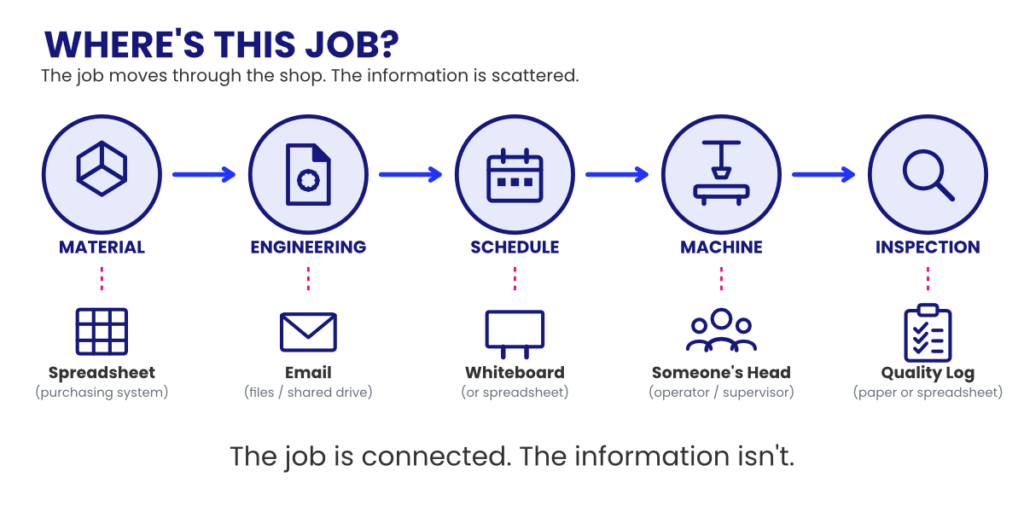
Long before delivery dates slip, production leaders spend their day answering basic questions. Is the material staged? Did engineering release the latest revision? Is the machine actually running what the schedule says?
When those answers live across different spreadsheets, inboxes, and people’s memory, keeping an accurate picture of the shop gets harder every week. Teams spend more time coordinating the work than doing it.
How the Breakdown Unfolds
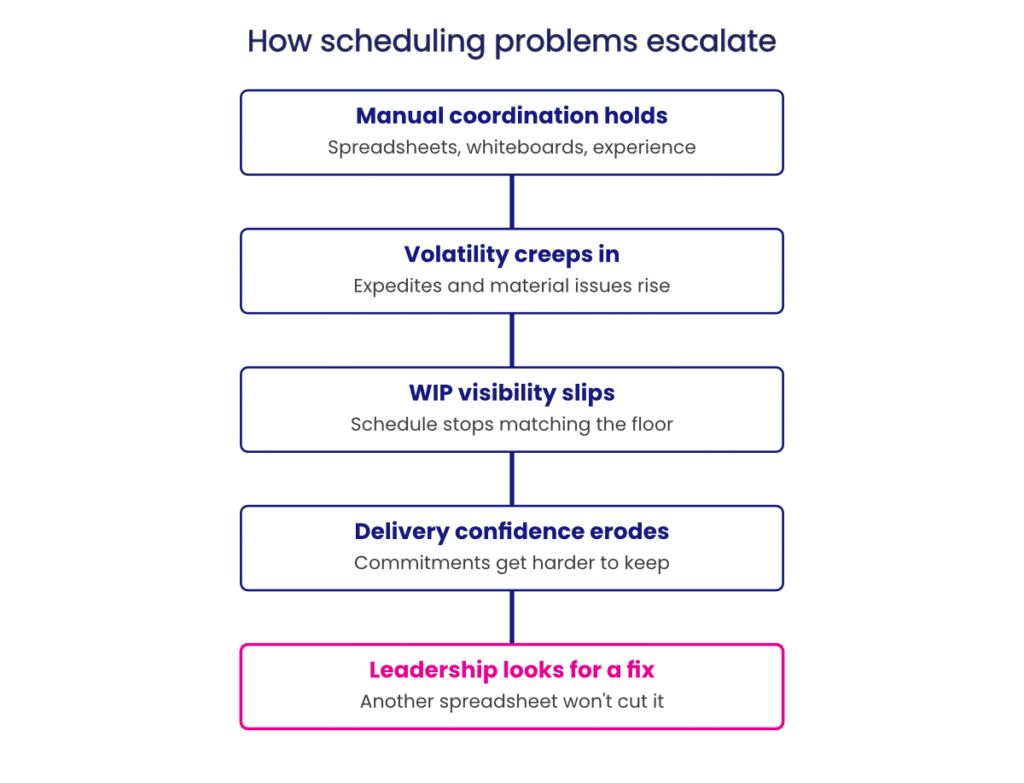
The Actual Fix Isn't a Better Scheduler
A shop doesn’t need to run out of machine hours to hit a growth ceiling. If priorities shift constantly, WIP is hard to track, and every expedite throws the floor into scramble mode, the limiting factor probably isn’t capacity. It’s coordination.
The CNC shops that scale well aren’t always the ones with the most machines. They’re the ones that manage growing complexity without losing efficiency or delivery confidence.
The Bottom Line
By this stage, the problem usually isn’t the person running the schedule. It’s that scheduling depends on information scattered across the business: production needs what purchasing knows, engineering changes need to reach the floor fast, quality requirements shape routing. When these functions live in disconnected systems, even a great scheduler is stuck guessing.
This is usually when manufacturers start looking at a connected ERP platform. The goal isn’t replacing a spreadsheet with software, it’s giving scheduling, inventory, purchasing, engineering, and quality one shared source of truth: real-time job and WIP visibility, capacity-aware scheduling, and updates that reach the floor as soon as they happen.
Is Your Shop Outgrowing Manual Scheduling?
If constant schedule changes, limited WIP visibility, and disconnected information are making production harder to manage, see how Acumatica can connect scheduling, inventory, and production data in one system.
See How Acumatica Supports Connected Manufacturing Operations →MetaForge IT Solutions helps manufacturers connect scheduling, inventory, and production data with Acumatica Cloud ERP.