
For a growing electronics manufacturer or Electronic Manufacturing Services (EMS) provider,
QuickBooks is a reliable starting point. When your production volumes are manageable,
component counts are low, and engineering changes are rare; standard accounting software works
fine.
However, electronics manufacturing carries a unique operational burden. Eventually, growth
introduces a level of complexity that exposes the limits of disconnected systems.
For mid-market electronics firms, that tipping point almost always hits between the $8M and $12M
revenue mark. At this stage, the problem isn’t that QuickBooks stops working for your finance
team; the ledger still balances and invoices still go out. Instead, the real issue is that your business
has evolved into a highly complex operational engine, while your software infrastructure is still
behaving like a small-business accounting tool.
The Real Issue Isn’t Accounting—It’s Fragmented Operations
Most EMS leaders don’t replace QuickBooks because of financial reporting limitations. They
replace it because their shop floor, warehouse, and engineering departments are fracturing under
the weight of manual processes.
To compensate for what QuickBooks cannot do, teams naturally build a web of manual
workarounds to keep production moving:
- Production schedules live in a complex, fragile Excel sheet managed by a single planner.
- Inventory tracking relies heavily on tribal knowledge, physical counts, and safety stock
hoarding. - BOM revisions are managed via disparate email threads, verbal updates, and paper
printouts.
At $5M in revenue, these workarounds feel flexible and agile. At $12M, they become severe
operational bottlenecks. Data must be manually entered multiple times across isolated systems,
tracking Work-in-Process (WIP) becomes a guessing game, and answering a customer’s simple
status request requires tracking down a production manager on the physical shop floor. The
organization consumes more energy managing its internal chaos than it does serving its
customers.
Electronics Complexity Scales Faster Than Standard Software
Electronics manufacturing is uniquely demanding. Unlike simpler discrete manufacturing
environments (like metal stamping or plastic molding), an EMS provider or electronics Original
Equipment Manufacturer (OEM) must constantly balance hundreds of rapidly shifting variables
simultaneously.
When you scale past $8M, the sheer volume of data points breaks down entry-level systems.
The Realities of Electronics Scaling vs. Entry-Level Software
| Operational Reality | The QuickBooks / Spreadsheet Bottleneck |
| High Component Counts & Multi-Level BOMs | Manual entry errors lead to wrong parts ordered, halting surface-mount technology (SMT) lines. |
| Engineering Revision Control (ECOs) | Engineering changes don’t reach procurement in time, causing expensive component scrap. |
| Supply Chain Volatility | No real-time visibility to manage long lead times or easily source alternate manufacturer part numbers (MPNs). |
| Strict Traceability Requirements | Tracking component serial numbers and lot codes requires grueling, error-prone manual paperwork. |
When you are forced to stitch together separate software tools just to maintain daily production
flow, the hidden cost isn’t just inefficiency. It is massive organizational strain, eroding gross
margins, and a direct threat to quality of delivery.
The Three Operational Breaking Points of the QuickBooks Ceiling
When a growing electronics manufacturer hits the ceiling of their current system, the cracks
usually appear in three specific, high-risk areas.
- The Spreadsheet Reliance Becomes a Liability
When production scheduling, procurement coordination, and material forecasting live inside
spreadsheets owned by a few key employees, your scaling model becomes incredibly fragile.
If a single spreadsheet formula breaks or a key scheduler is out sick, operations grind to a halt. You
no longer have an institutionalized system; you have a collection of fragmented habits. When
institutional knowledge is locked inside a single person’s desktop file, the business cannot scale
because it is entirely dependent on manual oversight to survive the day.
- Inventory Value vs. Inventory Reality
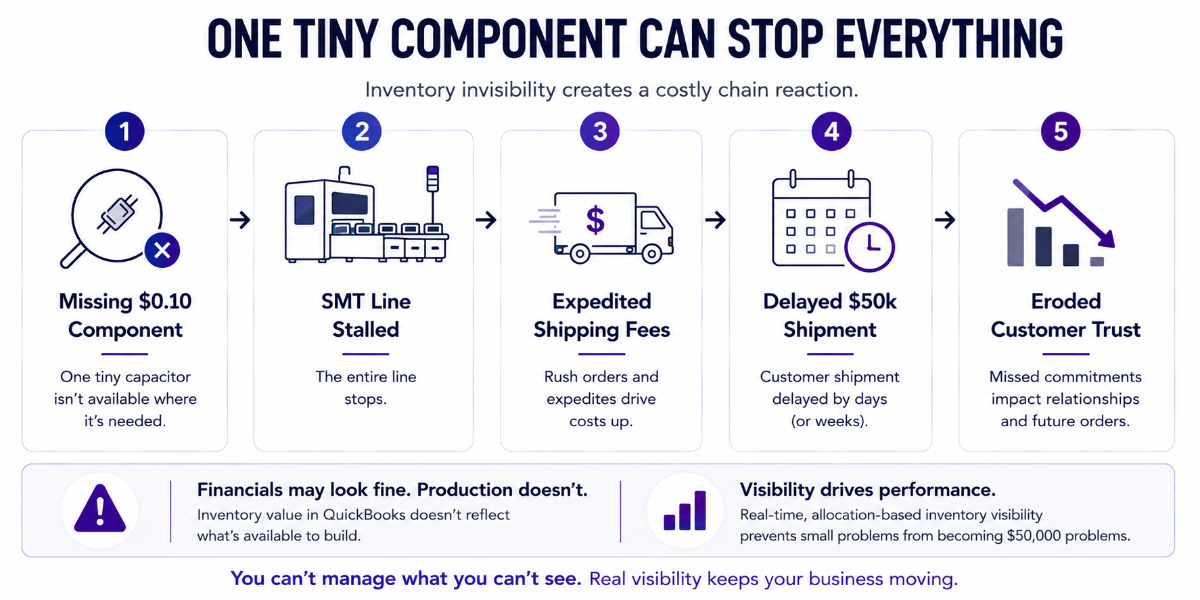
In electronics, a single missing $0.10 capacitor can stall a $50,000 shipment. Because QuickBooks
tracks inventory from a purely financial perspective (dollar value on hand), it cannot reflect
operational reality on the floor. It doesn’t know the difference between raw inventory, allocated
inventory for an active job, and quarantined material waiting for inspection.
Without real-time, allocation-based inventory tracking, purchasing teams operate blindly. The
result is a vicious cycle: constant expediting fees, shifted production schedules, shrinking margins,
and missed delivery dates. - The Engineering-to-Production Drift
As revenue grows, the communication gap between engineering and the shop floor widens. If an
engineering revision or BOM update doesn’t flow cleanly into your purchasing and production
systems in real time, the consequences are immediate: incorrect builds, outdated revisions on the
floor, costly rework, and wasted capital.
QuickBooks possesses no native concept of an Engineering Change Order (ECO). Therefore,
managing a revision change requires human perfection across multiple departments—a strategy
that breaks down under high-volume production.
Moving from Reactive to Scalable Growth
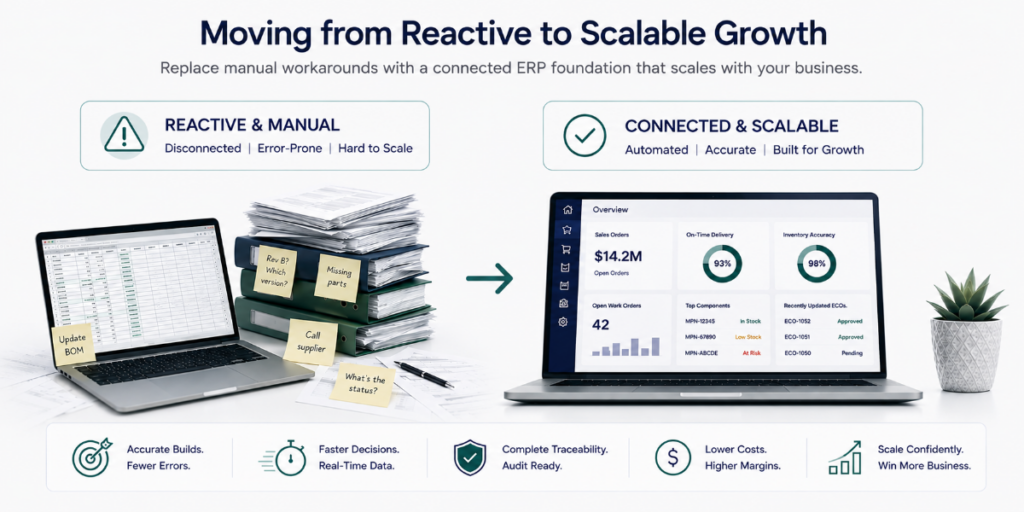
Growing electronics manufacturers eventually realize they don’t just need better software—they need operational infrastructure. Success past the $10M mark requires a shift from human-
dependent workflows to system-driven workflows.
Modern manufacturing Enterprise Resource Planning (ERP) environments unify inventory,
procurement, scheduling, BOM management, ECO tracking, and financials into a single,
connected ecosystem. Instead of departments operating as disconnected islands, information
flows across the business in real time:
- Dynamic Material Planning: An MRP engine reads your active sales orders, checks existing
inventory, evaluates current component allocations, and outputs a precise purchasing
schedule based on component lead times. - Shop Floor Visibility: Digital routing and tracking allow managers to see exactly where a
batch of printed circuit board assemblies (PCBAs) sits in the production cycle—whether it’s
in paste, pick-and-place, reflow, or final inspection. - Real-Time Cost Integration: Actual material costs, landed costs, and labor times are
captured directly on the shop floor, giving management true visibility into job profitability
rather than relying on standard cost estimates.
Evaluating an ERP isn’t just about fixing today’s spreadsheet chaos; it’s a strategic decision to
prepare for the next stage of growth. The manufacturers that scale most effectively are those that
recognize the limits of their systems early—before operational strain impacts their margins,
quality, and customer satisfaction.
Ultimately, transitioning from QuickBooks isn’t an accounting upgrade. For a growing electronics
manufacturer, it is an operational maturity milestone that unlocks the capability to confidently bid
on larger contracts, handle stricter compliance audits, and scale revenue without linearly adding
administrative headcount.
Looking for a Clearer Path to Scale?
If your spreadsheets are pushing your production team to its limits and inventory discrepancies are
delaying shipments, it’s time to look under the hood of your operations.
[Download our free Operational Assessment Checklist for Electronics Manufacturers] to
identify exactly where your current systems are costing you
Welcome to WordPress. This is your first post. Edit or delete it, then start writing!
Hi, this is a comment.
To get started with moderating, editing, and deleting comments, please visit the Comments screen in the dashboard.
Commenter avatars come from Gravatar.